
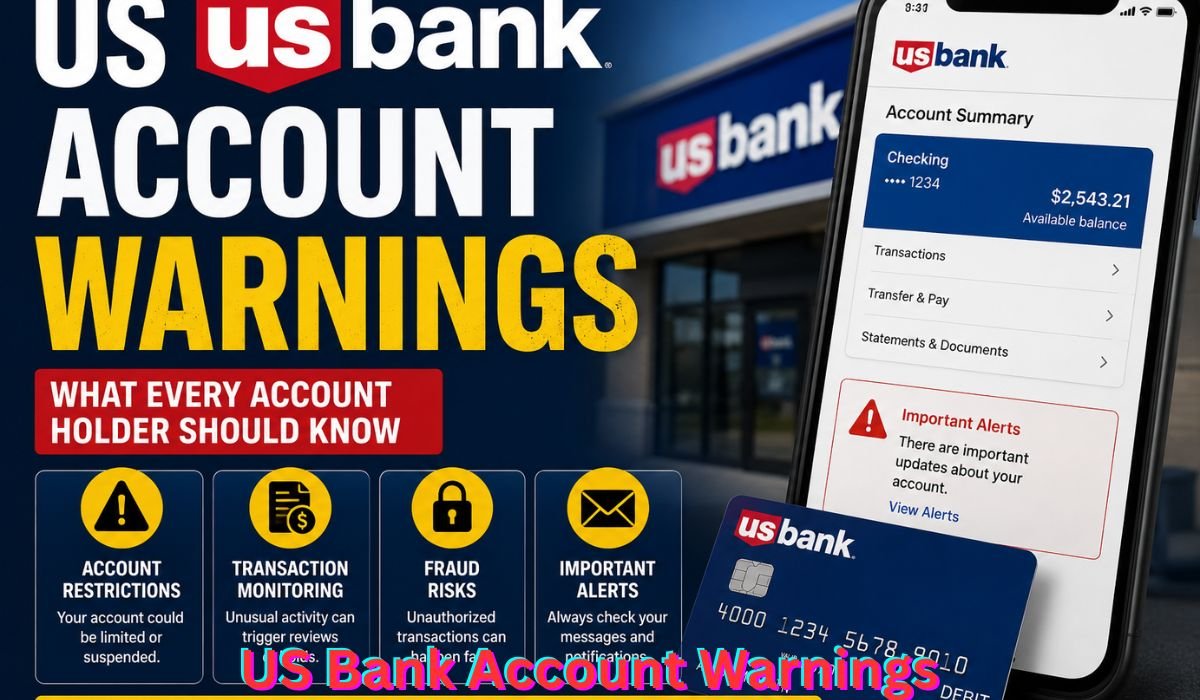
Most Americans assume their bank account is untouchable until it isn’t. US bank account warnings are rising across the country, and millions of people remain completely unaware of the triggers that can freeze or permanently close their accounts overnight.
Understanding these warnings isn’t just smart, it’s necessary. From financial institutions quietly flagging your behavior to scammers impersonating your bank’s fraud team, the threats are real, varied, and growing fast in 2025 and 2026.
Your Bank Account Can Disappear Overnight. Here Is What Nobody Tells You.
The Consumer Financial Protection Bureau confirms banks have the full legal right to close accounts often without explanation. A CFPB study revealed that six percent of bank accounts were closed involuntarily in a single year, leaving millions of Americans scrambling for access to their own money.
What makes this terrifying is the silence. No phone call. No letter. No warning. One morning your mobile banking app shows nothing. Bank account suspension and involuntary account closure happen more than most people realize, and the legal framework fully supports it.
| Risk Factor | Likelihood | Impact Level |
| Inactivity / Abandoned Property | High | Medium |
| Negative Balance | Very High | High |
| Suspicious Activity Flag | Medium | Very High |
| Identity Discrepancy | Low–Medium | High |
What Is a US Bank Account Warning? Understanding the Landscape
A US bank account warning is any alert from your bank, a regulator, or a consumer agency signaling your account faces suspension, closure, or fraudulent access. These come from the Federal Trade Commission, the CFPB, state banking regulators, or directly from banks like US Bank, Chase, or Bank of America.
Knowing which type of warning you’re facing shapes your entire response. A scam alert demands different action than a policy notice from your bank.
- Direct bank notices overdraft warnings, suspicious activity flags
- Regulatory warnings issued by CFPB or FTC about industry-wide threats
- Fraud and scam alerts impersonation schemes targeting customers of Wells Fargo, Citibank, Capital One, and others
The 7 Reasons US Banks Can Close Your Account Sometimes Without Warning
Banks are businesses with legal authority and wide latitude. These seven triggers are the most common reasons Americans lose account access often with zero advance notice from their financial institutions.
1. Account Inactivity The Abandoned Property Rule
Under state escheatment laws, accounts inactive for roughly three years may be deemed abandoned. Your funds get transferred to the state as unclaimed property, and the account is closed. A simple monthly login or debit card purchase resets the clock.
2. Negative Balance and Unresolved Overdrafts
Unresolved negative balance situations spiral fast. Daily overdraft fees pile up, and if unpaid within 30–60 days, the bank closes the account and reports it to ChexSystems potentially locking you out of checking accounts for up to seven years.
3. Suspicious Activity and Fraud Flags
The Bank Secrecy Act requires banks to file suspicious activity reports with the Financial Crimes Enforcement Network. Accounts flagged for structuring transactions, unusual cash deposits, or pass-through account activity can be frozen immediately with no warning permitted.
4. Policy Violations and Terms of Service Breaches
Running business income through a personal account, violating transaction limits, or breaching acceptable use provisions can trigger closure. US Banks and most major institutions explicitly warn customers that misuse of accounts ends the banking relationship.
5. Early Account Closure Patterns
Frequent early account closure activity is tracked by consumer reporting agencies. Opening and shutting multiple accounts rapidly raises red flags and makes mainstream banks reluctant to approve future account application history requests.
6. Name Discrepancies and Identification Issues
The customer identification program under federal anti-money-laundering regulations requires exact identity verification. Identity discrepancies between your account records and legal documents especially after name changes can trigger account restriction or full closure.
7. Association With Flagged Joint Account Holders
Your joint account holders matter more than you think. The CFPB confirms that a co-holder’s fraud flags or unpaid overdrafts can appear in records linked to your own identity, affecting your ability to open accounts elsewhere.
| Closure Trigger | Who It Affects Most | Prevention |
| Inactivity | Secondary account holders | Monthly login + transaction |
| Negative Balance | Low cash-flow users | Low-balance alerts |
| Fraud Flag | High-volume transactors | Consistent, explainable behavior |
| Joint Account Issues | Shared account holders | Vet co-holders carefully |
ChexSystems: The Banking Blacklist Most Americans Have Never Heard Of
ChexSystems is a specialty consumer reporting agency like a credit bureau, but for banking history. It’s a subsidiary of Fidelity National Information Services and is regulated by both the CFPB and FTC. Roughly 80% of banks use it to screen new account applicants, making a negative record genuinely life-altering.
Most Americans have never heard of it. That’s exactly the problem.
What ChexSystems Tracks
ChexSystems records unpaid negative balances, involuntary account closures, returned payments, check bouncing patterns, deposit history, debit history, and joint account relationships with flagged individuals. Even your account application history is stored and visible to member banks.
- Unpaid overdrafts and negative balances
- Suspected fraudulent activity
- Patterns of excessive returned payments
- Joint account links to flagged individuals
How a ChexSystems Record Affects You
A negative ChexSystems record can block you from opening accounts at virtually any mainstream bank, forcing you toward expensive alternatives. This creates a cycle of financial access barriers that can last up to seven years from the reported event date.
- Denied new checking accounts or savings accounts
- Forced reliance on costly nonbank check-cashing services
- Difficulty establishing direct deposit arrangements
- Reduced access to basic financial management tools
How to Get Your Free ChexSystems Report
Under the Fair Credit Reporting Act, you’re entitled to one free ChexSystems report every 12 months. Visit ChexSystems.com to request yours through their consumer assistance portal, or request one by mail. If a bank denies your application citing ChexSystems, you can request a free report immediately.
- Visit ChexSystems.com use the consumer request portal
- Request by mail or phone if preferred
- Review carefully for banking compliance errors and outdated entries
Disputing Errors on Your ChexSystems Report
Because ChexSystems falls under the Fair Credit Reporting Act, it must investigate consumer disputes promptly. Submit a written dispute with supporting documentation. The agency is legally required to respond and correct verified errors; this is your right, and it works.
- Submit written dispute with documentation
- ChexSystems must investigate and respond
- Errors, once proven, must be corrected or removed
Your Options If You Have a Negative ChexSystems Record
A negative record isn’t the end of your banking access. Second-chance checking accounts, offered by many credit unions and community banks, let you rebuild your banking history. Safe checking accounts, prepaid debit cards, and credit unions with flexible criteria are also solid paths forward.
- Second-chance checking accounts at credit unions
- Safe checking accounts with basic debit card access
- Quality prepaid debit cards with mobile app access
- Community banks with more flexible approval criteria
Early Warning Services (EWS): The Second Banking Watchlist
Early Warning Services is owned by a consortium that includes Bank of America, Capital One, JPMorgan Chase, PNC Bank, Truist, US Bank, and Wells Fargo. It also operates Zelle. Like ChexSystems, EWS shares negative banking history with member banks, and many large institutions use both systems simultaneously to screen applications.
You’re entitled to a free EWS report at earlywarning.com request it, review it, and dispute any errors you find.
| Agency | Operated By | Report Access | Retention Period |
| ChexSystems | Fidelity National Information Services | ChexSystems.com | Up to 7 years |
| Early Warning Services | Major bank consortium | earlywarning.com | Up to 7 years |
US Bank Account Scam Warnings: The Threats Targeting Your Account Right Now
Beyond institutional risks, US Bank customers face organized, sophisticated scams engineered to steal online banking credentials and drain accounts. The Consumer Financial Protection Bureau, law enforcement, and major banks have all issued formal warnings and the scam activity is escalating.
Knowing what these scams look like is your first line of defense against bank fraud prevention failures.
The US Bank Fraud Department Impersonation Scam
Fraudsters call US Bank customers posing as fraud department representatives, claiming issues with wire transfers and requesting account verification codes or credentials. The Wisconsin Department of Health Services issued a formal bulletin about this scam in December 2025. US Bank will never call asking for your full account number or password, hang up and call 800-USBANKS directly.
- Scammers use spoofed caller ID to appear legitimate
- They reference real wire transfers to sound credible
- Always call US Bank back using the official number
Phishing Emails and Text Messages
Phishing emails and texts impersonating Chase, Bank of America, Wells Fargo, and US Bank direct victims to fake websites designed to capture online banking credentials. These phishing attacks look convincing but legitimate banks never request passwords or Social Security numbers via email or text.
- Never click links in bank emails or texts
- Type the official URL directly into your browser
- Two-factor authentication adds a critical security layer
Account Takeover Through Social Engineering
Social engineering attacks involve criminals posing as bank employees and walking victims through fake verification steps that gather enough information for a full account takeover. A spoofed caller ID makes calls appear to come from your bank’s official number making these scams dangerously convincing.
- If pressured to act immediately hang up
- Call your bank back directly using the number on your card
- Never approve wire transfers over an unsolicited call
Zelle and Peer-to-Peer Payment Scams
Zelle, operated by Early Warning Services, is a primary target for peer-to-peer payment scams. Once sent, Zelle transfers are nearly impossible to reverse. The CFPB took enforcement action against Block, owner of Cash App, in 2025 for security failures that left accounts vulnerable. Treat every Zelle transfer like handing over cash.
- Only send Zelle payments to people you personally know
- Verify the recipient through direct, independent communication
- Never send money under pressure or urgency
How to Set Up US Bank Account Alerts: Your Real-Time Protection System
Account activity alerts from US Bank give you real-time visibility into every transaction, login, and change your fastest tool for catching unauthorized transactions before they cause lasting damage. Setting them up takes minutes and costs nothing.
Fraud detection systems only work if you’re paying attention and alerts make that automatic.
Setting Up Alerts in US Bank Online Banking
Log in at usbank.com and select the bell icon on your online banking dashboard. Choose Settings, then Account activity. Select Quick setup for recommended alerts or All settings for full customization. You can manage alerts separately for each account you hold.
- Log in → bell icon → Settings → Account activity
- Choose Quick setup or customize through All settings
- Manage per account for full control
Setting Up Alerts in the US Bank Mobile App
Open the main menu in the mobile banking app, select Notifications, then Account activity. Use the dropdown to select the account you want to manage, and choose Quick setup or All settings for a custom configuration tailored to your preferences.
- Main menu → Notifications → Account activity
- Select account via dropdown menu
- Quick setup covers the most critical alerts instantly
The Alerts You Should Enable Immediately
These account security alerts give you the fastest possible response window when something goes wrong with your account:
- Large transaction alerts set threshold at $100 or less
- Low-balance alerts catch overdraft fees before they spiral
- Login notifications detect account takeover attempts instantly
- New payee alerts flag unauthorized bill pay additions
- Password change notifications immediate alert if credentials are altered
- Suspicious activity alerts flagged directly by fraud detection systems
10 Steps to Protect Your US Bank Account Starting Today
Financial fraud prevention doesn’t require expertise, it requires consistency. These ten steps address every major banking risk management threat covered in this guide and can be implemented today without special tools or knowledge.
- Step 1 Log in to every account monthly; one debit card purchase resets the inactivity clock
- Step 2 Enable all critical account activity alerts via the app or online banking dashboard
- Step 3 Check your account balance monitoring daily using the mobile app
- Step 4 Resolve any negative balance the same day it appears; call your bank proactively
- Step 5 Request your free ChexSystems and Early Warning Services reports annually
- Step 6 Enable two-factor authentication on every financial account monitoring portal
- Step 7 Never click links in bank texts or emails navigate directly to the official site
- Step 8 Keep your contact information current so online banking notifications reach you
- Step 9 Review your account agreement for acceptable use provisions and bank policy violations
- Step 10 Save the official customer service number for every bank where you hold accounts
What to Do If Your Bank Account Is Closed Without Warning
Account recovery after an unexpected closure requires immediate, structured action. Don’t panic but don’t wait either. How quickly you respond directly affects whether your funds are returned and whether the closure damages your long-term banking access.
- Step 1 Call the official customer service number immediately not a number from any text or email
- Step 2 Ask whether the closure is fraud-related this determines your next steps entirely
- Step 3 Request your ChexSystems and EWS reports to see what was reported
- Step 4 File a dispute investigation for any inaccurate information under the Fair Credit Reporting Act
- Step 5 Confirm your remaining funds will be returned banks must mail a check after closure
- Step 6 File a consumer complaints report with the Office of the Comptroller’s Customer Assistance Group at helpwithmybank.gov if the closure was wrongful
- Step 7 Open a second-chance checking account or use a prepaid debit card as an interim solution
Read Also This: Dakittieztittiez: Origin, Meaning, and the Rise of a Viral Internet Identity
US Bank Account Warnings by the Numbers: What the Data Shows
The data behind US bank account warnings tells a story most Americans have never seen and it’s more serious than most would expect.
| Statistic | Figure | Source |
| Accounts closed involuntarily in one year | 6% | CFPB Study |
| Banks using consumer reporting agencies | 80% | CFPB Research |
| Max retention on ChexSystems record | 7 years | Fair Credit Reporting Act |
| Highest vs. lowest involuntary closure rate gap | 14x | CFPB Research |
The gap between the bank with the highest involuntary account closure rate and the lowest is fourteen times proof that the financial institution you choose matters as much as your own banking compliance behavior. Scam activity targeting bank customers escalated sharply through 2025, with organized bank impersonation schemes operating across multiple states using spoofed caller ID to appear completely legitimate.
Frequently Asked Questions
Why did my checking access suddenly stop?
Banks may freeze accounts after unusual activity appears. US Bank Account Warnings often happen after large transfers or failed identity checks.
Can a bank close an account without notice?
Yes, some banks close accounts very fast for safety reasons. US Bank Account Warnings can appear before sudden account restrictions happen.
What causes problems with online banking access?
Wrong login attempts or suspicious devices can trigger alerts. US Bank Account Warnings may lock digital banking until verification finishes.
Why am I getting alerts from my bank every week?
Frequent alerts may signal risky transactions or outdated information. US Bank Account Warnings help banks monitor unusual spending patterns.
Can international transfers create account issues?
Yes, overseas transfers sometimes trigger extra reviews by banks. US Bank Account Warnings may appear during foreign payment verification checks.
What happens after suspicious activity gets reported?
Banks may pause transfers while security teams review transactions. US Bank Account Warnings usually ask customers to confirm recent activity.
How do I avoid banking security problems?
Keep account details updated and avoid suspicious payment links. US Bank Account Warnings become less common with secure banking habits.
Conclusion
Your bank account is not as protected as you think but it can be, with the right knowledge. From understanding escheatment laws and anti-money-laundering regulations to setting up suspicious activity alerts and monitoring your ChexSystems record, every step you take today reduces your exposure to tomorrow’s risk.
The Consumer Financial Protection Bureau, Federal Trade Commission, and major banks including US Bank, Chase, and Bank of America have all sounded the alarm. Now it’s your turn to act. Review your accounts, enable your alerts, request your free reports, and protect what’s yours before someone or something takes it away.
